Tips and Suggestions
Learning Origami
- Interest
- Patience with yourself and with the stupid author for not being clear
- A sense of humor
- Paper
- A group, forum, individual, you can talk to when you get stuck
Equipment
- Directions or plan for model
- Paper Now that's all that's absolutely necessary. But from a realistic stand point there are some things you could buy to make life easier.
- Get a good paper cutter. Staples has a good one that's not terribly expensive by Carl; it's available in a number of sizes, the smaller one has a 12 inch bed (RT 200) Professional Rotary Trimmer; it's $37.99. The next larger one is 15 inches, a useful size but the price is more than double. The steel cutting wheel is replaceable (easily) as is the cutting mat. The blades, the mats, and the trimmers are all available at Staples. The blades are available in straight cut, perforated, and some decoratives for pretty edging (which is more useful for scrapbooking) but can put some pretty finishes on origami (kirigami) pieces. The underside of the rotary trimmer bed has a compartment for storing extra blades. And for an additional $6.95 a handle is available to use the blades as a hand cutter, Craft Cutter CC-10. Carl really has a nice product here, the handle has a pivoting angle locking head so it can be used right or left handed. It's nice solid tool and makes cutting really large paper quite easy. The Carl rotary trimmer is not perfect. It's very difficult to try and cut anything smaller than 2 inches because the cutting rail is fixed. But it's very good and I think for the money it'll be difficult to try and beat it.
- If you can, invest in a self healing cutting mat. It'll save your tables, floors, and carpets and it helps prevent damage to your cutting tools. I waited until Joann Fabrics had a sale and bought a 24 inch by 36 inch Olfa Mat for 40% off, which is normally $49.99.
- Buy some paper clips. The most versatile ones are the medium sized ones, but there are occasions when the large ones come in handy. You can of course buy a mixed package. I haven't found any significant difference between brands; I recently bought a package of 100 at Staples for $1.28.
- Make sure you have a good metal ruler and a metal yard stick. You'll be needing them. There are also some very nice quilter's rule guides, for cutting hexes and triangles. They may be something you find invaluable.
- Glue is something purists don't wish to discuss, nor have anywhere near their work. I, however, think you should buy, have, whatever tools and/or equipment that will make your work easier. So get glue. I buy Elmer's Glue-All Multipurpose Glue for large projects. Because it dries clear and it can be thinned down with water. It also is thin enough that it can be applied through an injector. However because of the length of the drying time, I use a glue stick when I'm putting most modular pieces together. My preference is Elmer's All Purpose Glue Sticks. They go on smooth and dry clear. I don't like the Craft Bond Photo Stik because it doesn't dry clear, and I find it more noticeable on light colored papers. I've used the UHU Glue Stiks and they're pretty good, but I find they dry a bit quicker than I move, and I have had some trouble with the glue clumping up when it's applied. I hate the repositionable glue because it takes too long to grab for my taste. It is available if that's something you like. If you're going to be working with plasticized papers you'll need a stronger glue. I don't personally do much with plasticized papers because they don't like to be creased and you have to wait while the glue takes hold. You'll need a cyanoacrylate glue. Read the label before you buy and test the glue before you start your project. There are times when you'll want to get glue in small, tight, little spaces and I found it useful to keep a flavor injector around. I fill the barrel with Elmer's glue and inject it in the spaces I couldn't reach with the bottle. Just make sure you buy a model which can be completely disassembled and don't let the glue dry inside the injector. Wash with warm water and soap as soon as you've finished using the glue. I recently found a glue injector in a wood working catalog. I haven't received my order yet, so I can't tell you how well it works but once I know I'll share the information with you.
- Another product Elmer's makes is called Art Paste, it's sold in 2oz boxes and makes about 4 quarts of paste when mixed according to the directions. I don't know who all carries it, I've purchased it at Dick Blick's and there are online sites where it can be purchased. This is a terrific product. It mixes easily and keeps for quite awhile in an airtight container. It does a terrific job at backcoating paper and sizing,or resizing paper. It dries clear and without (in my experience) significant color change to the paper. Methylcellulose is always an option for these purposes but why bother if you've got Art Paste.
- Keep large storage bags on hand, 1 or 2 gallon bags, because they make it easy to keep paper and unfinished models clean while they're in progress.
- You may also want to get some Sterilite or Rubbermaid storage tubs, because after you get started, even including throwing models away and giving them away to everyone you meet you'll find you have an ever increasing amount of models accumulating in your house.
- Get a three ring binder (notebook) to keep diagrams you download from the internet, or pick up from magazines, etc. There's nothing quite so maddening as not being able to locate the diagram(s), you know you have, for a partially finished model.
- If you have occasion to display something you've folded you should seriously consider how it's going to look. A simple base can make a model's presentation look much more professional, and complete. There are all sorts of display stands available for purchase. But not everyone has or wants to spend more for displays than they did for materials for the model, which is why I and a number of CAPS members have resorted to simpler but still effective display stands. The easiest and cheapest is to purchase small wooden plaques from Michael's crafts. (Other craft stores may carry the same products.) The plaques are pine, they come in a number of different shapes, and there are two basic sizes one which is about 3 inches and one about 6 inches. Then give them a quick coat of paint, drill a hole in the appropriate spot and glue a paper clip (end stretched out) or pin in place. If you need some additional stability you can add a pinch of poster putty on the inside of the model. (This is not museum quality mounting. This is craft fair, art show, quick, simple, inexpensive mounting.)
Miscellaneous Items
- Keep an empty ball point pen around it's handy for scoring lines. Or you can buy a burnishing tool, Michael's Crafts has them.
- It's nice to have a bone folding tool as well as a bone scoring tool. It makes folds sharper. Also it's nice for opening small points. Any number of places have these including Dick Blick's.
- You'll find it handy, although not absolutely necessary to have a protractor.
- Get some small, sharp scissors, that cut smooth lines. A narrow tip is handy to get into small folded areas. Cutter Bee makes a real nice pair which can be purchased at WalMart for $6.99.
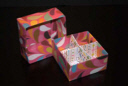
- You will need some kind of container(s) to keep your folding paper. I found it impossible trying to deal with all the cellophane packaging. I bought some square boxes, 7.25 inches a side, at Michael's crafts for $2.99 each and I store my kami paper in them. I kept the cardboard from the packages of paper and added colored tabs to the tops and use them as dividers in the box of paper. This way the paper is clean and dry, easily accessible and I can see fairly quickly how much I have of an individual paper. Whatever you decide to do, keep your paper flat.
Paper
- The local craft stores have some origami paper, Michael's Crafts has more of an assortment, than Hobby Lobby. But Dick Blick and Hobby Lobby have some packages of large squares, which Michael's doesn't carry. They both carry some kits as does Barnes & Noble bookstore. A kit can be a decent way to start. You may find you don't like the models in the kit, sometimes the paper isn't good. Try and avoid friable paper because you'll get your model half folded and the paper will split on you and ruin the whole thing. Acid free, lingen free paper will last the longest. The beauty of waishi and chigiyogami paper can breathe life into any model.
- For packaged kami paper of a single color you'll have to order from the internet unless you find a local store that carries single color packages. In Columbus, Ohio there's a store in the Kenney Center called Hana Gifts which carries a real variety of kami paper, including single color packages. There are also some beautiful foils, as well as textured papers. There's mesh paper and numerous prints, single and double sided with solids and pattern. Make sure in all cases to test that a paper will work before you commit yourself to it, but the other caution is when you've selected the paper (and you know this particular one is what you'll use for this project) buy all that you'll need to complete the project in one go. Otherwise, you're asking for trouble. The paper will go out of stock, or be discontinued, or the color will change just a tiny bit and the project will get sidetracked, perhaps permanently.
- Don't worry about the paper being acid free initially, buy paper you like which isn't going to break you financially. Scrapbook paper can work well. Check the paper before you commit to a large quantity of it. Some of the scrapbook papers just don't hold up well to folding. I've also been pleased with the success of using gift wrap and craft paper. Don't try to use heavily embossed paper, because it doesn't want to hold the creases. If you figure out a way to make it work let me know. Gift wrap and craft paper have the advantage of allowing you to cut whatever size you want from the paper. And when you're folding models that require 600 to 700 sheets of paper, you'll find you're either working with smaller paper, or you're trying to reduce the cost per sheet of the paper you're using. Some of these papers get what I call bruising. I can't tell you why, just that when you fold these papers every wrinkle, crease and line shows up white. It's as if the coloring is only on the surface. So check the paper before you begin so you don't waste a lot of time or money on paper that's not going to work for these purposes.
- Hobby Lobby has a good selection of scrapbook paper and if you watch their sales flyer, it goes on sale fairly frequently, sometime 3 sheets for a dollar, sometimes 50% off. Just watch and try and time your purchases to save some money. Archivers in Columbus, has a huge selection of scrapbook paper, but their prices are quite high and I have seldom seen it on sale. JoAnn's also frequently puts their scrapbook paper on sale, so watch for the sales. Gift wrap, has really become a hit and miss proposition. In the past, Hallmark stores would have been ideal for buying quality gift wrap, but since the onset of gift bags, not so much. It's worth checking, but don't count on it. The Container Store, at Easton in Columbus, Ohio is a great place to pick up gift wrap. They have a good sized selection, make sure you read the label. Not all the rolls are a continuous roll, some of them are two (or just one) cut sheet. You'll need to adjust your purchased quantity. And as I've said repeatedly, don't buy a lot until you know it's going to work. (I bought the prettiest red foil paper at Christmas, thinking I would use it for ornaments, and it would have looked great. But once I started folding the paper, the foil seperated from the backing paper and came apart and wrinkled and made a mess. It didn't work at all. Fortunately, I had only purchased the one roll.) The price per roll, can be fairly high but if you compare it to the average gift wrap you purchase at WalMart, you'll see that it's worth the difference.
- If you use letter paper, or printer paper avoid paper with a watermark. Wausau has some pretty colors available in their packaged papers. They also have 3.5 inch square note cubes, which are 555 sheets of paper, and sell for $5.49. They are available in pastels or Astrobrights. I have only found the note cubes at Office Max. The paper is colored on both sides. You'll find it handy to keep some small square paper around. It's easier to carry in your pocket to have for folding models while you're on the go. It's also handy to have around for doing modulars (which can require hundreds of pieces of paper for one model).
- Staples used to carry Wausau paper but has stopped and now offers their house brand of colored paper. (Personally, I don't like the colors anywhere near as much as the colors in the Wausau papers.) I have not tried folding with Staple's house brand paper, although several members of CAPS choose Staple's paper for their work. The Wausau paper doesn't bruise, holds a crease beautifully, is strong and durable and I use it most often when I want a solid color paper.
- Because, I've had difficulty obtaining the reams of Wausau Astrobrights, I've taken to ordering it online. Amazon, has several office supply vendors that sell the Wausau paper. Watch for sales and prepare to take a hit on the shipping charges. I recommend buying more than one ream at a time, because you're not going to save any money (due to the weight of a ream) buying a single ream.
Books
There are a multitude of books available and I can not list or address every book, but I can tell you something about some of the books I have worked with and those which I have found particularly helpful.
I recommend that you find opportunities to examine books before you buy them because it's hard to tell with "how to" books if you're going to like a book before you've seen it. Check out the books at the library and bookstores. If you have access to an origami group that's a good place to peruse books. Some of these books are very expensive so look for sources that offer the best prices.
You may find as you progress through your exploration of origami that you are particularly interested in a specific topic or type of origami. You may also find that you like a particular author/artist. When you're starting out, stick with authors whose work interests you and whose diagrams you can follow. As you become more comfortable with reading diagrams, stretch yourself, explore authors you haven't worked with and eventually you'll find you don't need the text to be in English (if it is well diagrammed).
The thing about anyone's recommendations is that their opinion is based on their interests and experience which may not coincide with your own. However, for what it's worth, the following ten books were particularly helpful to me: Origami Jewelry by Ayako Brodek. She's got very good directions; the book is beautifully photographed and she provides good assembly tips for jewelry pieces. Peter Engel's Folding The Universe is an invaluable resource. It will change the way you see paper and think about folding. This is a must have book. I was tempted to add all of Tomoko Fuse's books because I am especially interested in modular origami and Tomoko is a prolific author so there are a plethora of books to choose from. I limited my selections to Origami Boxes, Patchwork Quilts, and Unit Origami Multidimensional Transformations. Working on modulars is not unlike working on a puzzle. Often it's more difficult to assemble the model than to actually fold the units. These three books cover a spectrum of modular origami possibilities. If you think you might be interested in modulars you should look for one of these titles. Eric Gjerde's book Origami Tessellations is a terrific book. If tiling is something you've been interested in trying, you have to get this book. It has the best diagrams for tessellations that I've seen anywhere. Origami For the Connoisseur by Kunihiko Kasahara is a marvelous book because you see works by numerous artists and have diagrams to try their models. Advanced Origami by Michael LaFosse is one of many beautiful books that Michael has authored. He not only offers ideas for folding but has generously included recipes for making origami paper. Origami Design Secrets by Robert Lang is another must have book. This is truly a seminal work; generations to come will be influenced by work which has and will develop as a result of this book. If you intend to explore origami as an art, you must read this book. And finally Origami to Astonish and Amaze by Jeremy Shafer is a joyful book full of suprising and fun ideas. His ideas are creative and fresh, this book is not just another origami book.
The following list is but a few of the many titles of the various origami books. If you're a beginner most of the following titles won't be appropriate for you. But as you become more proficient and accomplished as a folder any of these titles would make a nice addition to your origami library.
- Afonkin, Sergei and Hull, Tom - Russian Origami
- Ansill, Jay - Origami Sourcebook
- Araki, Chujo - Origami For Christmas
- Beech, Rick - Decorative Origami Boxes
- Beech, Rick - Origami The Complete Guide to the Art of Paperfolding
- Boun, Tem - Awesome Origami Jets That Fly Volume I
- Boursin, Didier - Advanced Origami
- Brill, David - Brilliant Origami
- Brodek, Ayako - Origami Jewelry
- Burczyk, Krystyna - Twirl Kusudamas I
- Chatani, Masahiro - Ondori Pop-Up Origamic Architecture
- Collins, John M. - Fantastic Flight
- Engel, Peter - Folding the Universe Origami From Angelfish to Zen
- Fuse, Tomoko - Floral Origami Globes
- Fuse, Tomoko - Kusudama Origami
- Fuse, Tomoko - The Mask
- Fuse, Tomoko - New Kusudama
- Fuse, Tomoko - Origami Boxes
- Fuse, Tomoko - Origami Rings
- Fuse, Tomoko - Patchwork Quilts
- Fuse, Tomoko - Spirals
- Fuse, Tomoko - Unit Origami Multidimensional Transformations
- Fuse, Tomoko - Unit Polyhedoron Origami
- Gjerde, Eric - Origami Tessellations Awe-Inspiring Geometric Designs
- Hull, Thomas - Origami Plain and Simple
- Hull, Thomas - Origami3
- Hwang, Joyce - Christmas Kirigami
- Fukumoto, Jodi - Hawaiian Style Origami
- Jackson, Paul - The Art and Craft of Paper Sculpture
- Jackson, Paul - Great Origami Projects
- Jackson, Paul and A'Court, Angela - The Ultimate Papercraft and Origami Book
- Japan Publications - 3D Origami Step-by-Step Illustrations
- Kaplan, Dorothy - Money Rose
- Kasahara - Origami New Discovery II
- Kasahara, Kunihiko - Amazing Origami
- Kasahara, Kunihiko - The Art and Wonder of Origami
- Kasahara, Kunihiko - Creative Origami
- Kasahara, Kunihiko - Extreme Origami
- Kasahara, Kunihiko - Origami For the Connoisseur
- Kasahara, Kunihiko - Origami Omnibus
- Kawahata, Fumiaki - Origami Fantasy
- LaFosse, Michael - Advanced Origami
- LaFosse, Michael - Origami Flowers
- LaFosse, Michael - Origamido
- LaFosse, Michael - Paper Art The Art of Sculpting with Paper
- LaFosse, Michael and Alexander, Richard L. - Origami Art
- Lang, Robert J. - The Complete Book of Origami
- Lang, Robert J. - Origami Animals
- Lang, Robert J. - Origami Design Secrets
- Mills, Crystal and Tubis, Arnold - Fun With Folded Fabric Boxes
- Mitchell, David - Mathematical Origami
- Momotani, Yoshihide - Insectology with Origami
- Momotani, Yoshihide - Lay Out a Garden With Origami
- Montroll, John - Dollar Bill Origami
- Montroll, John - Origami For The Enthusiast
- Moriyama, Toshikayu - Roses, Origami and Mathematics
- Mukerji, Meenakshi - Marvelous Modular Origami
- Mukerji, Meenakshi - Ornamental Origami Exploring 3D Geometric Designs
- Netto, Mario Adrados - Dragons, Witches and Other Fantasy Creatures in Origami
- Nguyen, Duy - Origami With Dollar Bills
- Nguyen, Duy and Fathauer, Robert - Origami Deluxe
- Palacios, Vincente - Origami From Around The World
- Petty, David - Origami 1-2-3
- Robinson, Nick - The Encyclopedia of Origami
- Robinson, Nick - The Origami Bible
- Rojas, Hector - Origami Animals
- Rozelle, Lew - Origami Ornaments
- Rozelle, Lew - Origami Rockets
- Rutzky, Jeffrey - Buga
- Shafer, Jeremy - Origami to Astonish and Amaze
- Tan, Teong Hin - Interlocking and 3D Paper Airplanes
- Tanteidan Convention - Volume 14
- Temko, Florence - Kirigami Home Decorations
- Van Sicklen, Margaret - The Joy of Origami
- Weinstein, Michael - Stationery Flight
- Widess, Jim - How To Weave Hawaiian Coconut Palm Fronds
- Yamaguchi, Makoto - Kusudama Ball Origami
- Yamaguchi, Makoto - Lovely Flower Origami
Websites
The following list is some of the websites that I have visited over the years and I found to be either useful or interesting. (If the links have failed then the addresses may have changed since the last time I visited.)
Informational (Photographs and/or diagrams)- David Lister
- Jim Plank
- Folds Net
- Origami Diagrams
- OriBlog
- Origami Modular
- Haligami
- Umulius
- Origami Modulari
- Pederson
- Pentabonitos
- Meenakshi Mukerji Modular Mania
- Tina's Origami
- Sarah's Origami
- Reef Ranger's Club
- Robert Lang Origami
- Peter Callesen
- Gilad's Origami Page
- Modelli e diagrammi
- Francis Ow's Origami Page
- David's Origami Page
- Palm Frond Art
- Peter Budai Origami
- Dennis' Origami Page
- Robert Gatliff's Origami Page
- Ben's Origami Site
- Komatsu Gallery
- Contemporary Origami by Takashi
- Mark Leonard's Origami Diagrams
- Click Resources
- Paper The World